Towing Banners for Fun, Profit and Improved Stick & Rudder Skills
Welcome to another episode of Stories about Flying
I’m your host, Rob Mark
Towing Banners for Fun, Profit and Improved Stick & Rudder Skills
A few weeks back, I was relaxing in the backyard, sipping a homebrewed iced tea listening to some jazz, when I heard a familiar sound. A small airplane flying nearby. Even with the music, I could tell the engine on this one was running at full power. While I couldn’t see it at first, the sound told me, the airplane was also moving slowly.
The bazillion trees in our neighborhood, made seeing the bird tough. Looking between them when I could, I finally spied a white Piper Cub chugging along southward.
I knew that sound, and that the airplane wasn’t in trouble … the Cub was towing a giant banner. Those things create tons of drag, and demand full power to keep the airplane flying. This one happened to be advertising the upcoming Chicago Air & Water show.
Suddenly, I found myself zooming back in time - about 50 years - to when a much younger version of myself, was training to become a banner tow pilot. Those 2 ½ years, were some of the most exciting and valuable flying, I did over my entire career.
Banner towing sort of reached out and grabbed me, during one of my regular visits to a local airport called Chicagoland, also known as 3CG. That airport has long since disappeared BTW. I often spent my free time, wandering between the rows of parked airplanes, because I was an airplane geek, before the term even caught on. Having been raised on taildragger flying, and as the previous owner of a 7ECA Citabria, I always gave those birds extra attention.
During one of my visits, I spied a red and white Citabria, a 7KCAB, stabled near the runway. As I walked closer, I noticed a few odd contraptions hanging beneath the wings and belly of the fabric covered bird. One, was a pair of cable attachment points beneath the vertical stabilizer, with a rope running forward toward to cockpit.
Peaking inside, the airplane looked like a twin of the one I’d owned, with just a few basic flight instruments and a control stick, except mine used a 115 hp Lycoming. This 7KCAB, was powered by a 150 hp Lycoming and weighed about 1650 pounds at gross. As I continued snooping, a voice behind me broke my concentration. “I’ll bet you’re wondering what the extra gear is for, eh?” That’s when I met Barry, a guy I’d soon be sharing the cockpit of the little Champ with.
Over a couple of Cokes and an hour’s conversation, Barry told me about his business – Chicago Aerial Advertising, based at 3CG. He said he the company flew banners along the lakefront as well as around a few of the sports stadiums like Soldiers Field, Wrigley Field and downtown Chicago’s Grant Park, especially during concert season.
I’m obviously dating myself, because flying around sports events, is no longer allowed in major cities where TFRs are now regularly established, in the name of aviation security. But this was back then.
Barry asked about my flying experience, and I told him I’d just flown through about 500 hours total time with a commercial, instrument and CFI rating. “Would you be interested in a job?” he asked. My eyes got kinda wide and I said, “Maybe,” If he could teach me the ropes I thought.
The money was actually pretty good too, which should have been a clue, that this flying demanded something extra from the pilot. But heck, I was a 24-year old kid up for the adventure of learning about the world of aerial advertising. With only one airplane, and just Barry and I as pilots, we kept the Champ pretty busy all year long.
Day one of banner tow pilot training began at Barry’s desk, where, using a model, he explained the process of picking up, flying with and later dropping a banner with the Champ.
We never picked up banners from the airport because there was too much local traffic. We worked from an empty farmer’s field, near the old Glenview Naval airbase also now shutdown, just east of Chicago Executive airport.
Here’s what Barry taught me the first day. “Imagine you’re standing at one end of this open field that’s maybe 1000 feet long. It’s clear of obstacles at both ends to allow for a safe approach and departure.”
“At the approach end of the field, two people are each holding a 15-foot tall poll, placed about 25 feet apart from one another. The banner itself, is probably 50 feet long, and holds the actual letters, arranged to spell out the message. “Go Bears,” or maybe “Lou Malnati’s Pizza – Chicago’s Favorite.”
I nodded understanding to this point, when he added, “There’s a rope at the end of the banner. That rope gets strung between the two 15-foot polls. We just fly down low between the polls, grab the banner and climb away to the target,” he said.
My job was then to tow the sign, to whatever location around Chicago the advertiser wanted, and spend an hour or so circling the event. Barry mentioned one very important rule. “The banner only reads correctly when the airplane flies in front of the audience from right to left, so it’s important to circle the event, counter-clockwise.”
Interesting I thought, but first I needed to learn how to pick up that banner.
The banners were laid out on the ground so I’d be grabbing it flying into the wind so my groundspeed would be slow. Back to the guys holding the polls. The pilot’s job to fly between the polls and grab that banner sounded … well, exciting, when I realized it meant flying close to the ground … as in about 10 feet above. “OoooKay.”
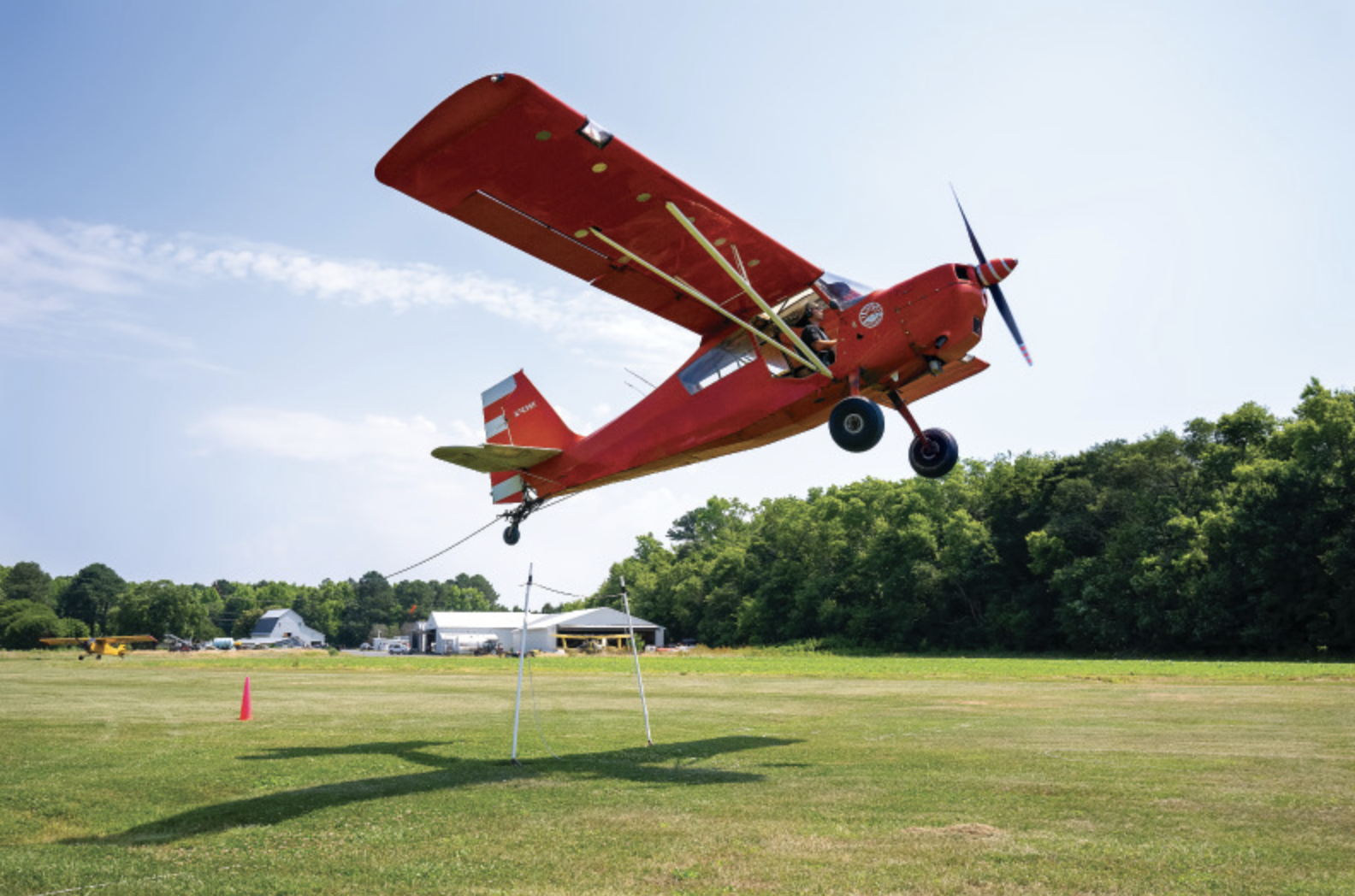
Inside the Champ’s cockpit there were those two ropes, with a hook attached to the end of each. The other end was connected to that metal bracket, underneath the rudder.
Barry told me enroute to the banner pickup field, I’d be throwing one of the hooks out the door … but gently. so it didn’t get tangled up with the tail. We also communicated with the ground crew, via a discrete radio frequency, to be sure we all understood the game plan for that run.
This is when the fun started …
With Barry in the back seat the first few times, talking me through the process, I approached the field, and descended down to about 25 feet AGL, as I turned about a quarter-mile final. I also slowed the Champ down to about 65-70 mph, before I opened the side door, and tossed out the hook.
As I approached the poles, I maintained 65-70 and as level as I could possibly fly. Any faster and I might pull the banner apart. Again, my job was to bring the hook, right up the middle between the two poles, and hopefully grab the rope on the end of the banner.
I remember asking Barry the first time, how I’d know if I’d been successful grabbing the banner. “Don’t worry,” he said. “You’ll know.”
OK. Here we go. I aimed the Champ toward the polls while firmly gripping the stick. This was no place for a mistake.
As I passed between the polls, I pushed the throttle all the way in, and firmly added back pressure on the stick. All seemed normal for a second or two until “clunk.” I connected with the banner, and realized what Barry meant, about knowing when I’d connected.
I felt myself pulled forward against my seatbelt and the airplane seemed to almost stopped in midair. That was my cue, to now reduce the angle of attack, with a push on the stick, so the Champ didn’t fall out of the sky. Now I just needed to steer the airplane straight to grab as much sky as possible.
On a cool spring or fall day with a few hours of fuel onboard, my rate of climb with the banner was often no more than 200-300 fpm. Once I reached about 600-700 AGL, I leveled off, and proceeded to the target. Of course, I also had to remember that big banner, was trailing way behind the Champ. Forget that and I might just snag a radio antenna, a water tank, or a building along the way.
I remember picking up a banner headed south on a hot summer day and telling the guys in Glenview tower I was coming by. I passed by their 150-foot water tower and was a tad lower that the top. That was kinda scary.
It usually took about half an hour’s flying time, to reach my target near downtown Chicago. Once there, I’d spend an hour circling the event. Once my cockpit timer rang, I’d head back to the pickup field.
Back at the field, I’d head upwind again and descend to 100 feet. As I passed the guys on the ground, I pulled a release lever on the cockpit floor, and the banner and its tow rope would sink back to the surface.
There were times, that I was able to carry enough fuel, to make two runs without landing, hence the second rope in the cockpit. But this didn’t happen often. In the summer, when the temperatures often soared into the 90s, the little Champ’s 150 horses, just weren’t enough to make it all work.
I learned much that first summer of banner towing, like the seriousness of balancing the Champ between a stall and the gentle climb necessary to reach the target at the proper altitude.
The advantage of Barry having hired a guy with previous taildragger time was that I knew how to move my feet and hence the rudder when it was necessary. With that big banner dragging behind me, turns demanded quite a bit of rudder to keep the ball even close to the center.
After 10 or 15 hours of towing, I realized I could feel what the airplane was doing without looking at the turn coordinator. With a big cockpit windshield, judging pitch was pretty easy too. This flying relied on looking out the windows and translating that into keeping your hands and feet moving. There wasn’t even a sliver of automation in those days.
Looking back on it, much of my first 500 hours was flown in airplanes that used a stick rather than a control wheel. I came to love it for the lighter touch in pitch and roll it taught me, something that carried with me for the rest of my career. I remember the first time I had an opportunity to fly an A380 in Toulouse. Shortly after takeoff, the instructor asked me if I wanted the automation. I declined in favor of hand flying the humongous aircraft. That seemed perfectly normal to me.
The last thing on Barry’s syllabus was emergency training. We discussed the Champ’s descent rate if the engine quit with that huge piece of drag chasing me around the sky. It would be nearly straight down.
In the event of an engine failure, the only memory item was simple. “Pull the handle and drop the banner,” He said. “Disaster will follow if you don’t.”
And what if the banner didn’t release over the pickup field when I pulled the handle on the way back? I learned I couldn’t make a normal approach with the banner behind me because it would quickly snag on the ground and put the airplane and me on its nose.
The trick – Barry said – was to approach the runway but remain a few hundred feet high even over the threshold. Then I’d chop the power and push the nose down toward the runway. This kept the banner behind and above me, and also prevented the aircraft from gaining much airspeed.
As the surface came up to greet me, I was supposed to flare and hope I could stop the airplane on the runway before the banner could touch the ground.
Luckily, I never encountered an emergency in my years of banner towing.
I loved every minute of banner towing, despite the danger. I know it made me a better pilot in later years.
If you enjoyed this episode of Stories about Flying, please follow the show … and tell a friend.
I'm Rob Mark. We’ll see you next time.
Your host, Rob Mark, brings 50+ years of experience flying for the airlines, corporate, charter, and as a flight instructor, as well as his previous life as a tower and radar air traffic controller for the FAA and while in the US Air Force. His experience also spans decades as an award-winning aviation journalist and podcaster.
Labor Day Explained